

The Future of Small Business in Australia: Why Restructuring Is Gaining Attention in 2026 and Beyond

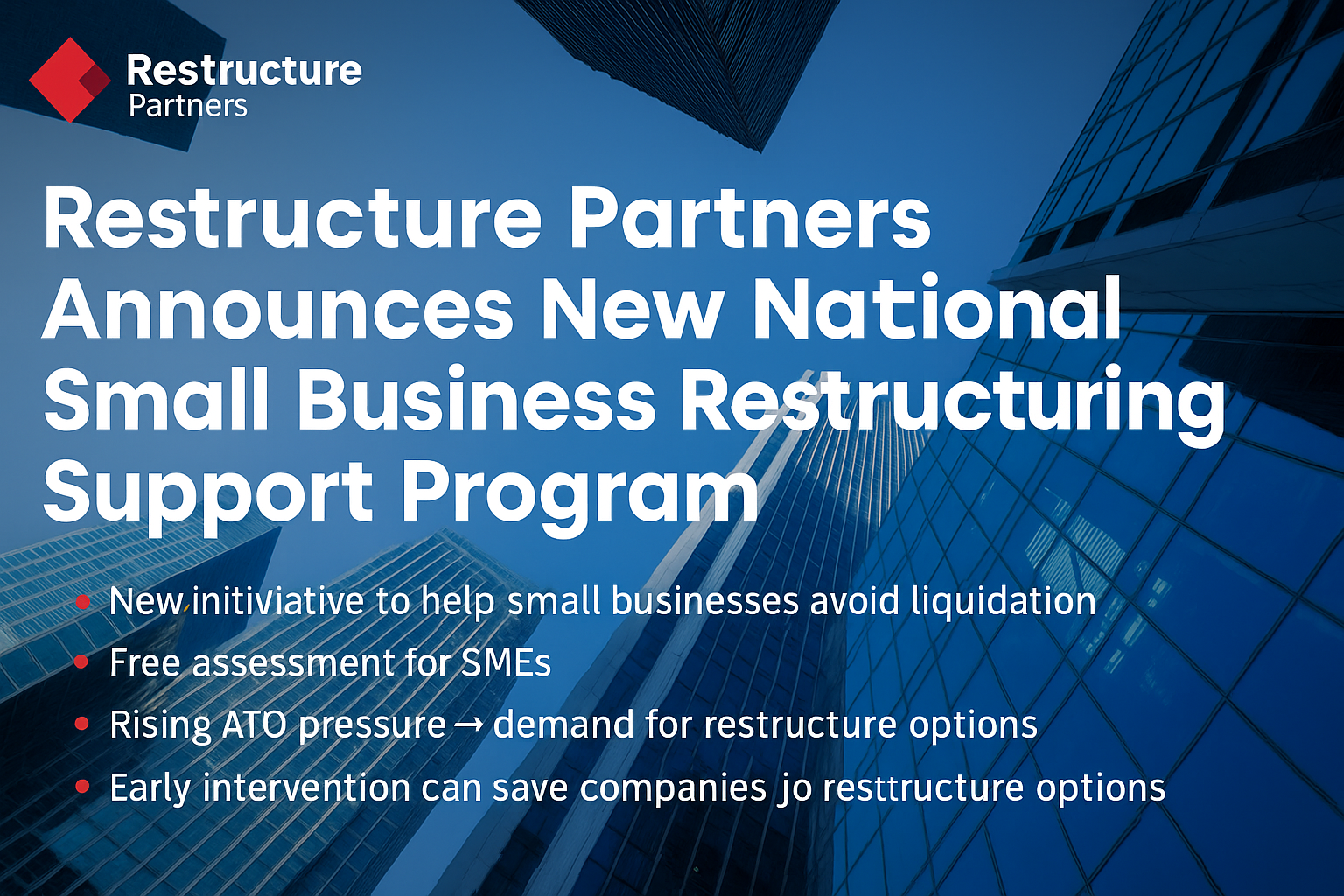
Restructure Partners
The story of Australian small business in 2026 is, at its core, a story about adaptation.
The story of Australian small business in 2026 is, at its core, a story about adaptation. The businesses that have navigated the disruption of the pandemic period.”
SYDNEY, NSW, AUSTRALIA, April 12, 2026 /EINPresswire.com/ -- The story of Australian small business in 2026 is, at its core, a story about adaptation. The businesses that have navigated the disruption of the pandemic period, the withdrawal of government support, the return of ATO enforcement, and the pressures of a high-cost operating environment have done so by making difficult decisions early — including the decision to seek formal professional help when informal approaches were no longer sufficient.— Restructure Partners
ReStructure Partners helps Australian directors navigate every stage of ATO and financial distress, from overdue BAS and tax debt through to Director Penalty Notices, restructuring solutions, voluntary administration, and broader insolvency options. As the firm looks at the trends shaping Australia's small business insolvency landscape in 2026 and beyond, several developments stand out as particularly significant for what lies ahead.
The firm works with directors and business owners across Australia to provide insolvency advice, restructuring support, and practical guidance tailored to each stage of the financial distress cycle.
Restructuring as a First Resort
Perhaps the most meaningful shift in Australian insolvency practice over the past five years is the growing acceptance — among directors, creditors, and the ATO alike — that restructuring should be explored before liquidation is assumed to be inevitable. This cultural shift reflects the maturation of the small business restructuring regime and a broader recognition that preserving viable businesses produces better outcomes for the economy than winding them up.
The ATO's publicly stated approach to restructuring plan voting — evaluating plans on whether they deliver a better return than a liquidation — has been a significant contributor. By signalling that it will assess plans on a commercial basis rather than reflexively opposing them, the ATO has made restructuring a more credible and accessible option for businesses that carry significant tax debts.
Information on the small business restructuring process and what it involves is available at https://restructurepartners.com.au/small-business-restructuring.
The Digitisation of Compliance and Enforcement
Looking forward, one of the most significant developments for small business is the ATO's continued investment in data analytics and real-time compliance monitoring. The single touch payroll system now captures PAYG withholding and superannuation reporting in real time, giving the ATO near-immediate visibility into whether a business is meeting its employer obligations.
This significantly reduces the period between non-compliance and ATO awareness — and by extension, the period between non-compliance and enforcement action. For directors, this development reinforces the importance of treating tax compliance as an ongoing operational priority rather than a periodic obligation.
The window between incipient non-compliance and formal enforcement action is narrowing. Businesses that fall behind on reporting and payment obligations will be identified more quickly than in the past.
The Role of Professional Advice in Business Resilience
The businesses that navigate financial distress most successfully in 2026 are not necessarily those with the least debt or the strongest trading positions. They are the businesses whose directors have access to qualified advice and act on it promptly.
In the future, it is likely that the role of restructuring advisers will expand beyond traditional crisis intervention to encompass a more proactive advisory function — helping directors identify financial risks early, manage ATO compliance obligations, and plan for contingencies that might otherwise escalate into crises. This proactive model is already emerging in parts of the market and is expected to become more prevalent as the profession adapts to the sustained pressures facing Australia's small business sector.
Directors seeking to understand the full range of restructuring and insolvency options available — now and in the years ahead — can access guidance at https://restructurepartners.com.au.
Looking Ahead
The future of Australian small business will be shaped in significant part by the decisions directors make today. The tools are available. The practitioners are experienced. The ATO is, in the right circumstances, a cooperative creditor rather than an adversarial one.
For directors navigating financial difficulty in 2026, the most important message is straightforward: the options available today are better than those that will remain available if action is deferred. Early advice, clearly applied, consistently produces better outcomes.
ReStructure Partners works with Australian directors and business owners experiencing financial pressure, including ATO debt, cash flow issues, and creditor stress. The firm provides support across the full spectrum of financial distress, from early-stage tax arrears and compliance issues through to Director Penalty Notices, small business restructuring, voluntary administration, and other insolvency pathways, depending on the circumstances.
Contact:
ReStructure Partners
https://restructurepartners.com.au
###
Restructure Partners
Restructure Partners
+61 468 061 936
email us here
Legal Disclaimer:
EIN Presswire provides this news content "as is" without warranty of any kind. We do not accept any responsibility or liability for the accuracy, content, images, videos, licenses, completeness, legality, or reliability of the information contained in this article. If you have any complaints or copyright issues related to this article, kindly contact the author above.
